The Times-Picayune (New Orleans) October 1, 1963
March to City Hall Made By Negro Demonstrator
Speakers Read Petition Asking Advances
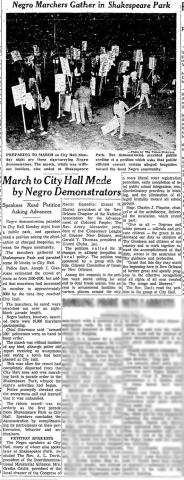
Negro demonstrators paraded to City Hall Monday night from a public park and speakers read a petition asking the elimination of charged inequities toward the Negro community.
The marchers gathered at Shakespeare Park and paraded some 22 blocks to City Hall.
Police Supt. Joseph I. Giarrusso estimated the crowd enroute as from 3500-4000 but added that marchers had increased in number to approximately 8000 by the time they reached City Hall.
The marchers, he noted, were stretched out over an eight-block parade length.
Negro leaders, however, as-serted there were 10,000 marchers participating.
Chief Giarrusso said “around 300” policemen were on hand to keep order.
The march was without inci-dent of any kind, although police did report receiving an anon-ymous call saying a bomb had been planted at City Hall.
This was after the crowd had completely dispersed from the City Hall area and was marching back in parade order to the Shakespeare Park, whence the night’s activities had begun.
Police promptly checked out the anonymous call and learned that it was unfounded.
The return march was as orderly as the first parade from Shakespeare Park to City Hall. Speakers concluded the demon-stration by complimenting its participants on their performance, behavior and enthusiasm.
PETITION REQUESTS
The Negro speakers at City Hall, many of whom also spoke later at Shakespeare Park, included The Rev. A. L. Davis, president of the Interdenominational Ministerial Alliance; Mrs. Oretha Castle, president of the local chapter of the Congress or Racial Equality;
Ernest N. Morial, president of the New Orleans Chapter of the National Association for the Advancement of Colored People; The Rev. Avery Alexander, president of the Consumers League of Greater New Orleans, and Gerald T. Thomas, president of United Clubs, Inc.
The petition called for 18 changes in alleged inequities in local policy. The petition was sponsored by a group with the title Citizens Committee of Greater New Orleans.
Among the requests in the petition were some calling for an end to dual trade unions, free access to amusement facilities in various places around the city, a more liberal voter registration procedure, early completion of total public-school integration,
nondiscriminatory practices in housing, and the elimination of alleged brutality towards all ethnic groups.
Msgr. Charles J. Plauche, chancellor of the archdiocese, delivered the invocation, which stated in part:
“Give us all – Negroes and white persons – officials and private citizens – the grace to understand our duty as children of The Goodness and citizens of our country and to work together toward the accomplishment of that duty, serene in the assurance of Thy guidance and protection.
“Grant that this day may mark the beginning here in New Orleans of further great and speedy progress in the effective recog-nition of all rights of all men created in Thy image and likeness.”
The Rev. Davis read the petition to the group at City Hall.